
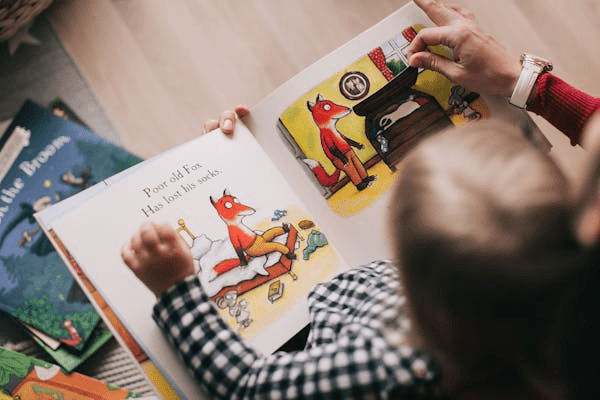
Children receive all kinds of literacy support at school…
…but this support should start at home. Parents play the most important role in early literacy development as they build the foundation for beginning readers. Simply talking to newborns and toddlers as if they are communicators is the first step in encouraging literacy development. Some of the most crucial learning happens in everyday moments such as reading aloud and singing together. This being said, many parents are unaware of the things they can incorporate into their routines to build up a strong literacy foundation.
Reading Routines
Reading with your child on a daily basis is crucial for literary development. An article from Ohio State University states, “Young children whose parents read them five books a day enter kindergarten having heard about 1.4 million more words than kids who were never read to, a new study found.” This increase in vocabulary development sets children up for success in the literary world. There are many ways to set reading routines up with children to kickstart their development. Starting reading traditions such as bedtime stories is a simple way to include reading into the day. Pointing out and reading signs on the road is an often overlooked opportunity to get some vocabulary in. Not only does reading together encourage reading, it is an optimal bonding experience, helps children develop a love for books and improve their language skills.
Treat Young Children Like Communicators
Engaging in conversation with children even before they are old enough to respond introduces them to vocabulary, encourages listening and speaking, and will assist with reading development. Parents can build childrens lexicon, or personal dictionary, before they even start speaking by narrating what they do around the child. With older children parents can grow their child’s vocabulary by explaining new words in books, TV, or conversation, and talking to children about their day. With younger children, parents can support listening and speaking by responding to cooing, singing songs, and making the sounds of animals in books.
Make Home A Literacy Rich Environment
By creating a space where reading is encouraged and supported, children are more likely to read recreationally and enjoy reading. Parents can do so by establishing home as a reading space by once again creating reading routines and daily reading opportunities. They may also wish to keep a variety of books accessible to children and go on frequent library trips. Playing literacy games either online or hands-on can be a very rewarding way to encourage reading. Parents can also encourage story-telling and create an environment where stories are supported and acknowledged.
Model Reading In The Home
Children often learn by modeling behavior they see from adults, so seeing adults reading for pleasure teaches them that reading can be done for fun and encourages them to read recreationally to expand their skills. These models can also spark curiosity in what adults are reading which can turn into a learning experience.
Seek Intervention For Issues In Development
All children develop reading skills at a different rate but there are red flags parents should know to look for. Genetics play a large role in reading development and difficulties, children with a sibling with reading difficulties are fifty percent more likely to also have reading difficulties. This can look like repeatedly mixing up letters when speaking. Mixing up letters is fairly common when developing speech and reading skills but should taper off by about age eight, if not this may be an area of concern. Another red flag is forgetting previously mastered words from around first to third grade. Or if the child refuses to read at all, this can be a sign of an underlying problem that creates an aversion to reading. If parents are concerned about their child’s reading development it may be of interest to get them assessed for reading disorders.
Resources
Raising Readers: What Parents Can Do | NEA
Reasons to Read with Your Child Daily | The Gardner School
The importance of reading to kids daily
11 Ways Parents Can Help Their Children Read | Reading Rockets
Early Literacy: Parents Play a Key Role – PACER Center
The Role of Parents in Supporting Early Literacy Development — Lerner Knows Literacy
Talking to Children Matters – Adriana Weisleder, Anne Fernald, 2013
Supporting Your Child’s Literacy Journey: A Parent’s Guide
When to actually worry that your kid still can’t read – Today’s Parent


Leave a comment